Learning how to write Facebook ad copy that converts fast is one of the most valuable skills a digital marketer can develop. Facebook's average conversion rate across industries sits around 9.21%, but top-performing ads often double or triple that figure. The difference almost always comes down to copy. Not design, not targeting, not budget.
The words you choose, the structure you follow, and the psychological triggers you activate determine whether someone scrolls past or clicks through. This guide breaks the process into four actionable steps that you can apply to your next campaign today.
Whether you're writing for e-commerce, SaaS, or local services, the principles here will help you write Facebook ad copy that converts fast and consistently.
Key Takeaways
- Strong hooks in the first line determine whether users stop scrolling or keep moving.
- Benefit-driven copy outperforms feature-heavy descriptions by a significant margin on Facebook.
- A clear, specific call to action lifts click-through rates more than any other single element.
- Testing multiple copy variations weekly is the fastest path to finding winning ad text.
- AI ad copy tools can generate dozens of variations in minutes, accelerating your testing cycles.
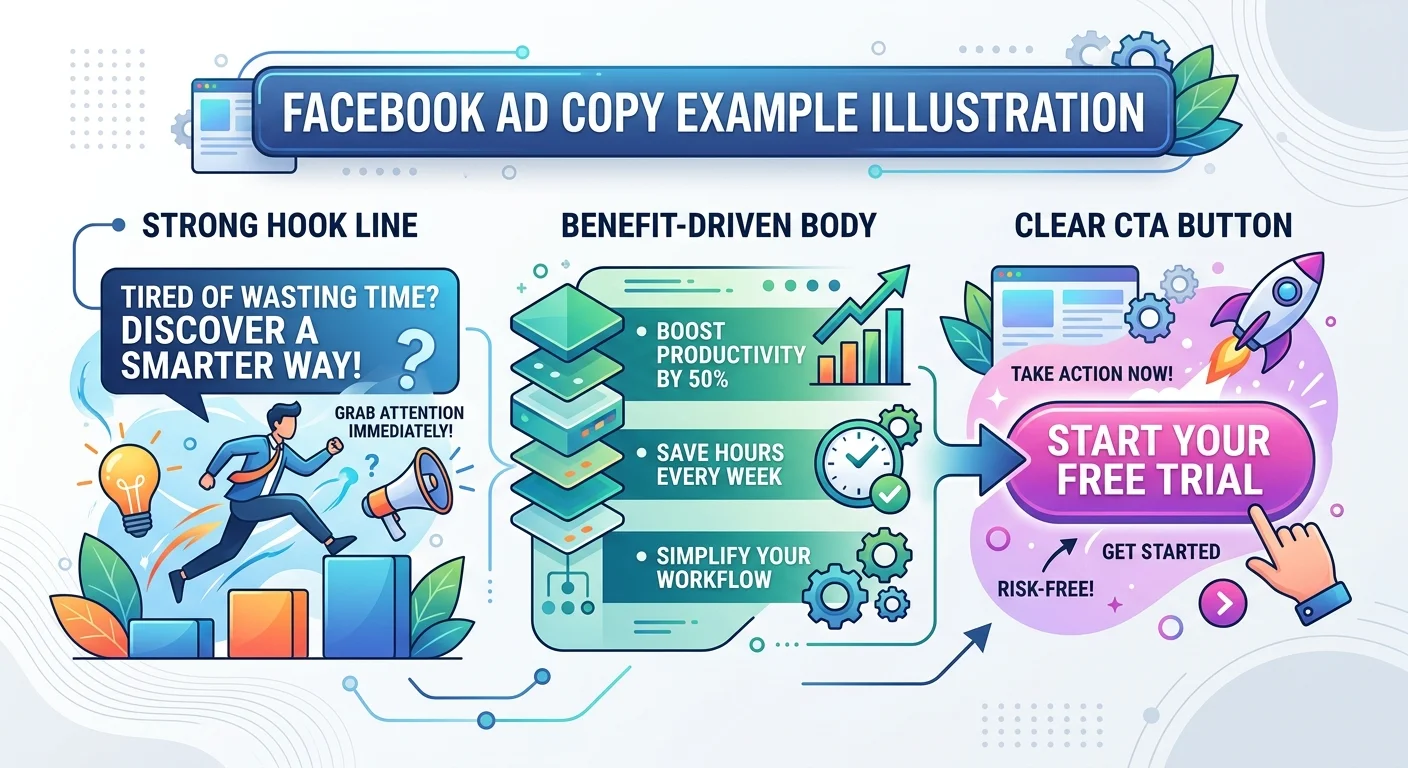
Step 1: Nail the Hook in Your Opening Line
Facebook shows only the first few lines of your ad text before truncating it behind a "See more" link. That means your opening sentence carries enormous weight. If you can't stop the scroll in those first 125 characters, the rest of your copy might as well not exist. According to Facebook's own data, mobile users spend an average of 1.7 seconds with a piece of content. Your hook needs to earn attention in less time than it takes to blink twice.
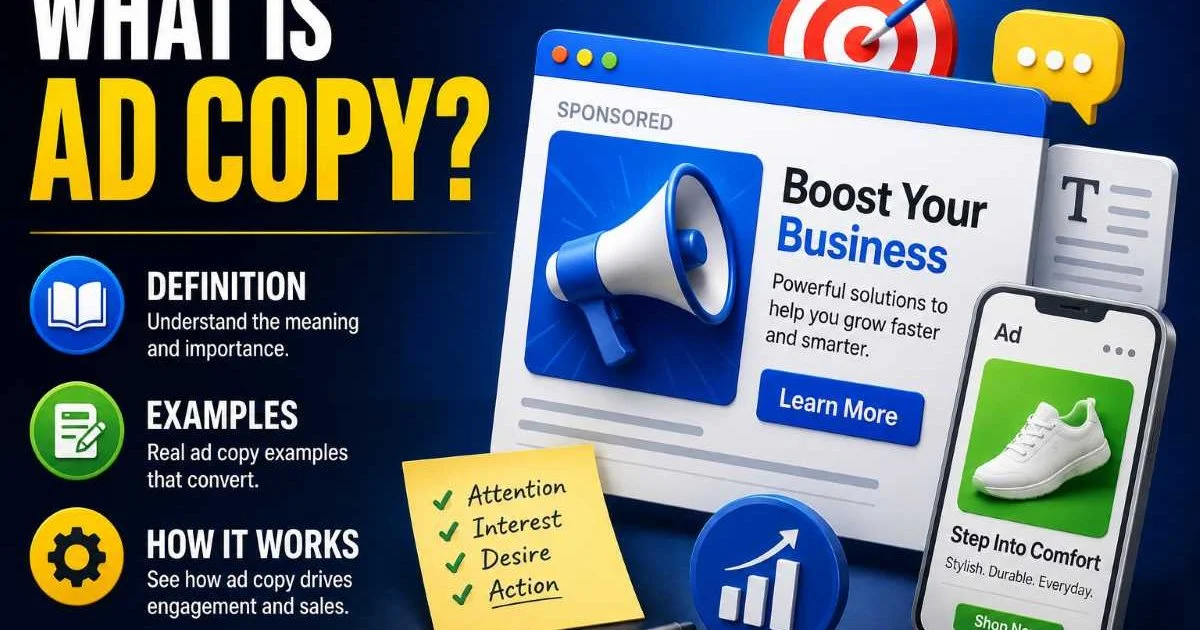
The most effective hooks address a specific pain point or promise a concrete outcome. "Tired of wasting $200/day on ads that don't convert?" works because it names a real number and a real frustration. Generic openers like "Looking for a better solution?" fail because they could apply to anything. Specificity is what separates high-performing ad copy from the noise in someone's feed. Understanding the fundamentals of what ad copy is and how it works gives you a foundation for writing hooks that actually resonate.
Three Hook Formulas That Work
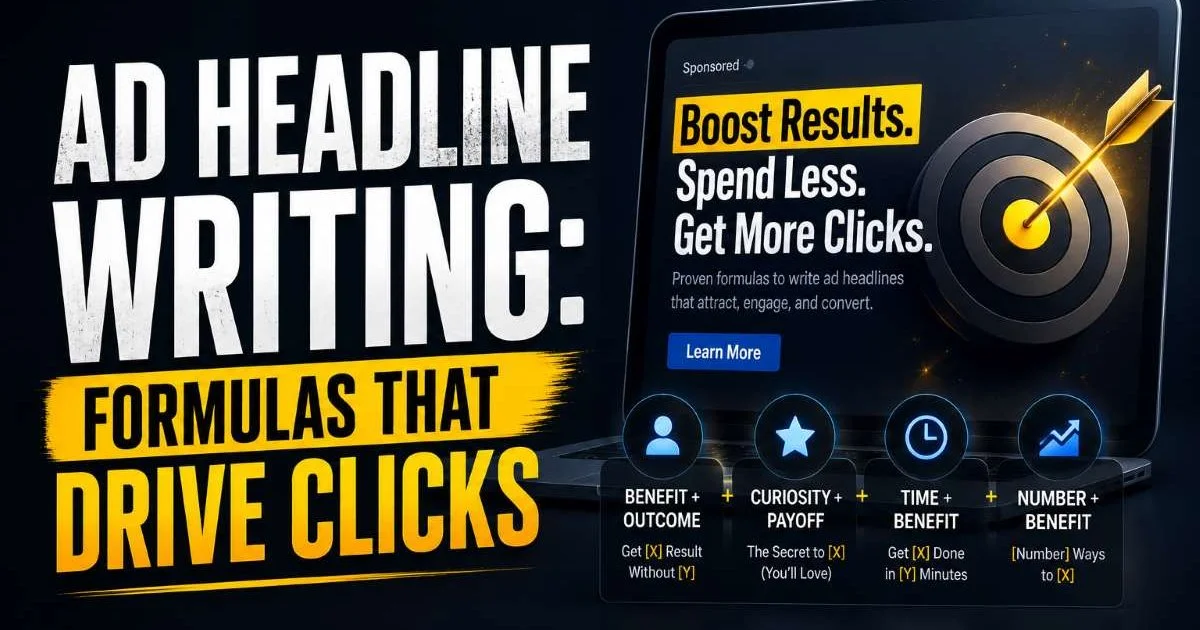
The Question Hook asks something the reader can't ignore: "What would you do with 10 extra hours a week?" The Proof Hook leads with a result: "We generated 347 leads in 14 days using this one change." The Contrarian Hook challenges a common belief: "Your Facebook ads aren't failing because of targeting." Each formula works because it creates a gap between what the reader knows and what they want to know. That gap is what pulls them past the "See more" fold.
Write at least five different hooks for every ad before choosing one. The first idea is rarely the strongest.
Test hooks in isolation before worrying about body copy. You can run the same offer with three different opening lines and have statistically meaningful data within 48 hours. The hook alone can swing click-through rates by 30% to 50%. This is why experienced advertisers treat the first line as the most important real estate in the entire ad. Get this right and everything else becomes easier.
Step 2: Structure Your Copy for Maximum Conversion
Once your hook earns attention, your body copy needs to hold it and direct it toward action. Unstructured paragraphs of text rarely perform well on Facebook. Users are scanning, not reading essays. The best-performing ads follow a clear framework that moves the reader from problem awareness to solution desire in under 200 words. Following proven Facebook best practices in your copy structure can meaningfully improve your results.
The PAS and AIDA Frameworks
PAS (Problem, Agitation, Solution) works especially well for short-form Facebook ads. You name the problem, amplify the emotional stakes, then present your offer as the resolution. AIDA (Attention, Interest, Desire, Action) is better suited for longer ad formats where you have room to build anticipation. Both frameworks give your copy a logical flow that mirrors how people actually make purchasing decisions. Pick one and commit to it rather than mixing approaches in a single ad.
Regardless of which framework you choose, break your copy into short paragraphs or bullet points. Wall-of-text ads consistently underperform because they feel like work to read. White space is your friend on mobile screens. Use line breaks generously, introduce emoji sparingly as visual anchors, and keep any single paragraph to three lines maximum. This formatting habit alone can lift engagement rates noticeably.
"The structure of your ad copy matters as much as the words themselves."
When you write Facebook ad copy that converts fast, the body section should do exactly three things: validate the reader's problem, present the offer clearly, and create urgency or scarcity. Anything that doesn't serve one of those purposes is padding that dilutes your message. Strip out adjectives that don't add meaning. Remove sentences that repeat a point already made. Tight copy respects the reader's time and rewards their attention with a clear path forward.
Step 3: Write CTAs That Actually Drive Action
Your call to action is where interest converts into clicks. Yet most advertisers treat it as an afterthought, slapping "Learn More" at the end and hoping for the best. Facebook's own research shows that ads with specific, benefit-oriented CTAs outperform generic ones by 22% on average. Instead of "Sign Up," try "Start Your Free Trial Today." Instead of "Shop Now," try "Get 30% Off Before Midnight." The CTA should tell the reader exactly what they'll get when they click.
Where to Place Your CTA
Place your primary CTA at the end of the body copy, right before the reader's eyes hit the image or video. But also consider embedding a softer CTA earlier in the text, especially for longer ads. A mid-copy prompt like "See how it works below" keeps the reader engaged and moving forward. This layered approach works because different readers reach decision readiness at different points. Some will click after the hook; others need the full pitch before they're ready.
Avoid using more than one competing CTA in a single ad. If you ask someone to "Sign up, follow us, and check out our blog" in the same copy, you've given them three decisions to make. That friction kills conversion rates. One ad, one goal, one CTA. This principle is simple but routinely ignored; even experienced marketers sometimes try to accomplish too much with a single piece of copy. Restraint is a competitive advantage.
Multiple competing CTAs in a single ad create decision fatigue and typically reduce overall conversions.
Match your CTA language to the Facebook button you select. If your ad copy says "Download the Free Guide" but the button reads "Shop Now," you've created a disconnect that erodes trust. Consistency between copy and button reinforces the expected action and reduces friction. Small misalignments like this are invisible to the advertiser but very noticeable to the user. Audit every ad for this alignment before it goes live.
Step 4: Test, Iterate, and Scale Winning Copy
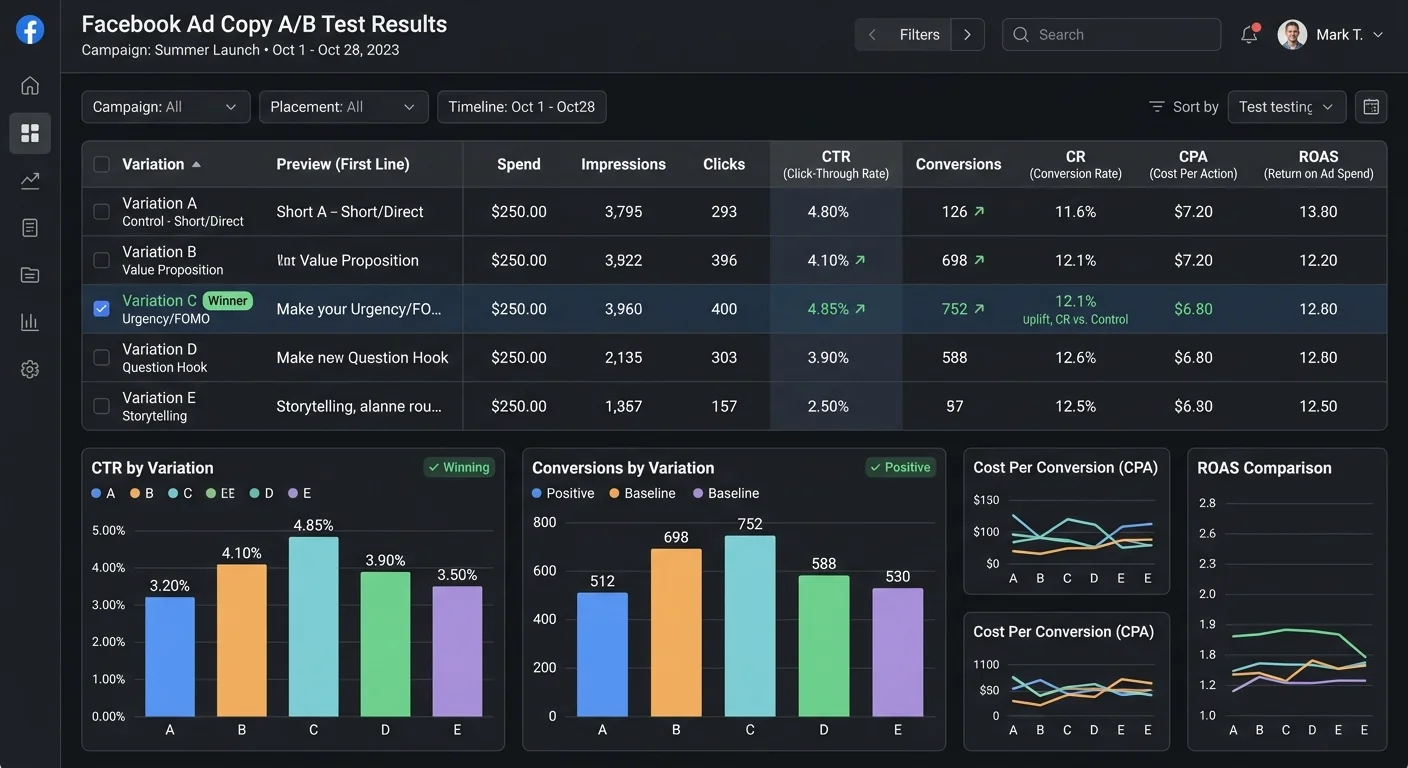
Even the most experienced copywriters can't predict which version will win. That's why systematic testing is essential for anyone who wants to write Facebook ad copy that converts fast. Meta's ad platform makes A/B testing straightforward, but most advertisers don't test enough variations. Running two versions isn't a real test. You need at least three to five copy variations per ad set to find statistically significant winners within a reasonable budget and timeframe.
What to Test First
Prioritize testing elements in order of impact. Start with hooks, then test body copy frameworks, then CTAs. Testing everything simultaneously makes it impossible to isolate what's working. Each test should change only one variable. If you change the hook and the CTA at the same time and performance improves, you won't know which change was responsible. Disciplined isolation is what separates real optimization from random experimentation.
AI-powered tools like the AI Ad Copy Generator can produce dozens of ad copy variations in minutes, giving you a much larger pool to test from. Instead of manually writing five versions and hoping one works, you can generate thirty variations, filter for the most promising, and let the algorithm find the winner. This approach dramatically compresses the testing timeline and helps you write Facebook ad copy that converts fast without burning through your creative energy.
AI-generated copy still benefits from human review. Always check variations for brand voice consistency and factual accuracy.
Once you identify a winning variation, don't just scale spend on it. Extract the principles that made it work. Was it the hook formula? The specificity of the benefit? The urgency in the CTA? Document these patterns in a swipe file that your team can reference for future campaigns. Over time, this library of proven copy patterns becomes far more valuable than any single winning ad. The goal isn't to find one great ad; it's to build a repeatable system for producing them.
Frequently Asked Questions
?How many hook variations should I write before testing?
?Does PAS or AIDA work better for Facebook ad body copy?
?How long does it take to find a winning Facebook ad copy variation?
?Is a generic opening line really hurting my Facebook ad performance?
Final Thoughts
The ability to write Facebook ad copy that converts fast comes down to mastering four areas: attention-grabbing hooks, structured persuasion frameworks, specific CTAs, and disciplined testing. None of these require creative genius.
They require process, practice, and a willingness to let data override your assumptions. Start with one campaign this week. Write five hook variations, run them for 48 hours, and let the numbers tell you what works. That single habit, repeated consistently, will transform your ad performance faster than any other tactic.
Disclaimer: Portions of this content may have been generated using AI tools to enhance clarity and brevity. While reviewed by a human, independent verification is encouraged.