Learning to write ad headlines is one of the most valuable skills any digital marketer can develop. Your headline is the first thing a prospect reads, and it determines whether they stop scrolling or keep moving. Whether you're crafting Facebook ad copy, Google Ads copy, or display banners, the headline carries roughly 80% of your ad's persuasive weight. A weak headline means wasted budget.
A strong one means clicks, conversions, and revenue. If you're still guessing at what works, you're leaving money on the table. This guide breaks down proven formulas that professional ad copywriters use every day to drive measurable results. For a broader foundation on what ad copy is, how it's defined, and how it works in practice, that context will make these formulas even more powerful.
Key Takeaways
- Headline formulas give you repeatable frameworks instead of starting from a blank page every time.
- Numbers and specificity in ad headlines consistently outperform vague or generic alternatives.
- Google Ads copy headlines follow different structural rules than Facebook or Instagram headlines.
- Emotional triggers like fear, curiosity, and urgency are backed by decades of direct response data.
- Testing two to three headline variations per campaign is the minimum for meaningful optimization.
1. Understand the Anatomy of a High-Performing Headline
Core Components Every Headline Needs
Every effective ad headline contains three elements working together: a hook, a value proposition, and a reason to act now. The hook grabs attention through surprise, a number, or an emotional trigger. The value proposition tells the reader what's in it for them. The urgency element, whether a deadline, scarcity cue, or implied cost of inaction, pushes them toward the click. Miss any one of these, and your headline underperforms.
Consider the difference between "We Sell Running Shoes" and "Run Your First 5K in 30 Days, Starting at $49." The second headline has a specific outcome (5K in 30 days), a clear value signal ($49), and implied urgency (starting now). David Ogilvy famously noted that five times as many people read the headline as read the body copy. That ratio hasn't changed much in the digital era; if anything, shorter attention spans have made it more extreme.
Platform Constraints Shape Your Approach
Your headline doesn't exist in a vacuum. Google Ads gives you up to three headline slots at 30 characters each. Facebook lets headlines run longer but competes with visuals and primary text for attention. Display ads typically limit you to seven words or fewer. Understanding these constraints before you start writing prevents wasted effort and forces creative discipline that often produces better copy.
| Platform | Headline Character Limit | Visible Headlines | Primary Focus |
|---|---|---|---|
| Google Search Ads | 30 per headline | Up to 3 | Intent matching |
| Facebook/Instagram Ads | 40 recommended | 1 | Scroll-stopping hook |
| LinkedIn Ads | 70 characters | 1 | Professional value |
| Display Ads (GDN) | 30 characters | 1 short, 1 long | Brand awareness |
| YouTube Ads | 15 characters | 1 | Curiosity trigger |
Always write your headline to the platform's limit first, then edit down. Starting long and trimming produces tighter copy than trying to fill a character count.
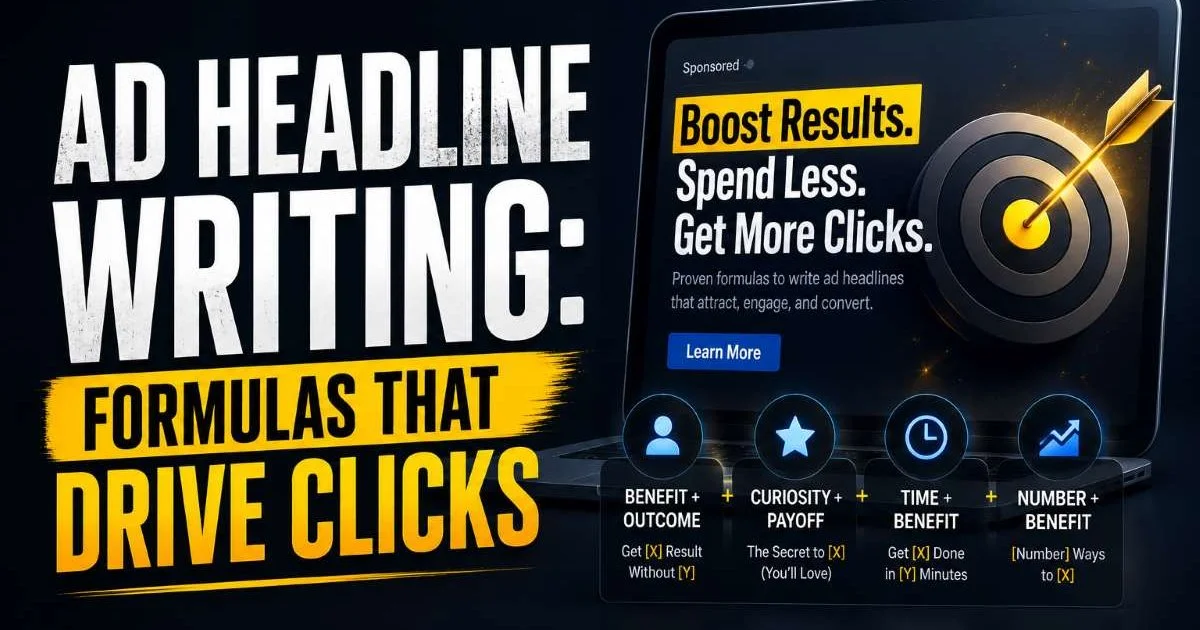
2. Master Five Proven Headline Formulas
The Benefit-Driven Formula
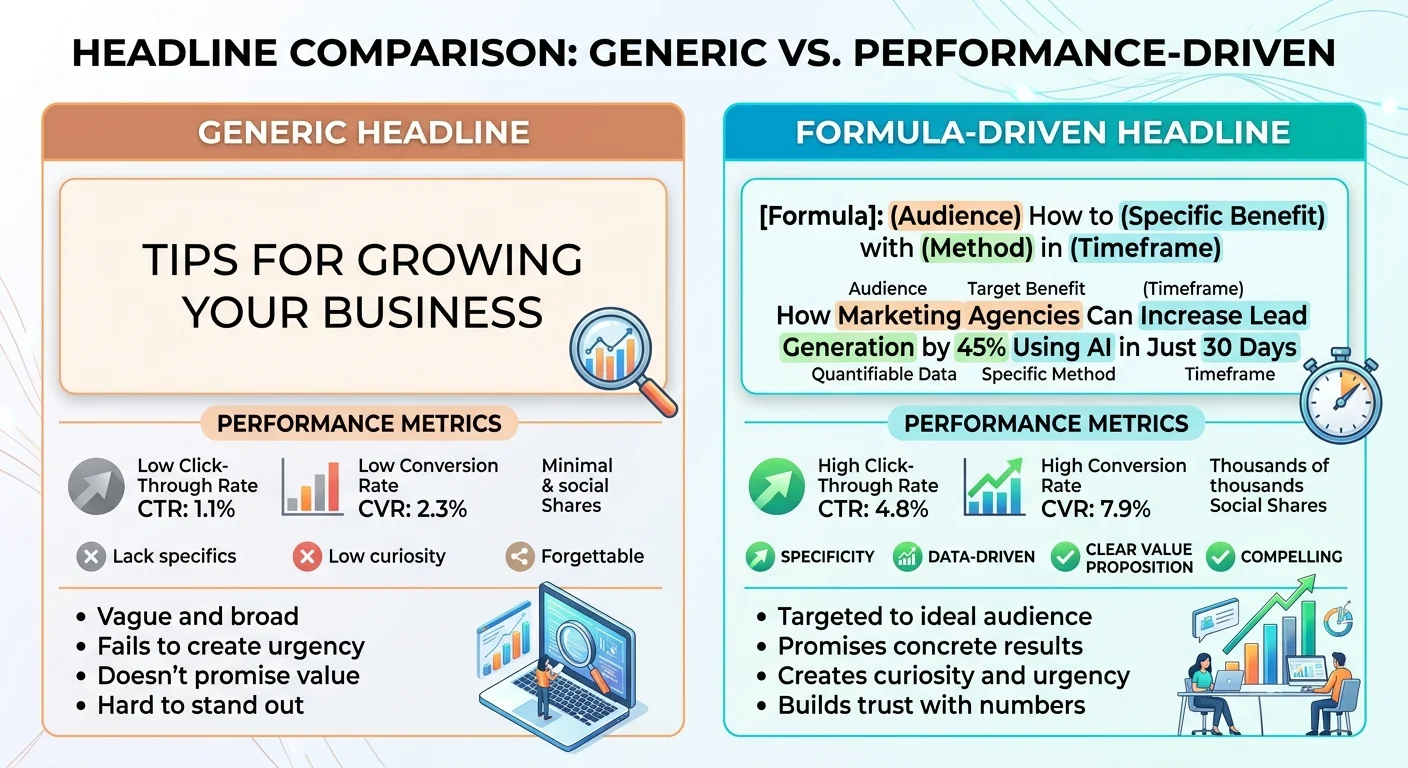
The most reliable headline formula puts the benefit front and center. The structure is simple: "Get [Desired Outcome] Without [Pain Point]." For example, "Get More Leads Without Cold Calling" or "Lose 10 Pounds Without Giving Up Carbs." This formula works because it simultaneously presents a positive outcome and removes an objection. It's direct, scannable, and immediately relevant to anyone experiencing that pain point.
A close cousin is the "Number + Benefit" formula. Headlines containing numbers get 36% more engagement according to research from Conductor. "5 Ways to Cut Your Ad Spend in Half" outperforms "Ways to Reduce Advertising Costs" because the number sets expectations and the benefit is concrete. When you write ad headlines with numbers, odd numbers tend to outperform even ones, and numbers under 10 feel more digestible and actionable to readers scanning quickly.
The Curiosity Gap and How-To Formulas
The curiosity gap formula teases information without giving it away. "The Headline Mistake Costing You 40% of Your Clicks" makes readers want to know what the mistake is. Used well, this formula drives strong click-through rates. Used poorly (clickbait with no payoff), it destroys trust and tanks your quality scores. The rule: always deliver on the promise in your landing page copy. If you're building a career around this kind of strategic thinking, understanding how to become an ad copywriter in 2024 gives you a roadmap.
The how-to formula is the workhorse of educational advertising. "How to Write Facebook Ad Copy That Gets 3x More Clicks" combines instructional framing with a specific, measurable promise. This formula works particularly well for B2B and SaaS products where buyers are actively seeking solutions. It positions your brand as a guide rather than a salesperson, which lowers resistance and increases trust in the ad itself.
"The best headline formulas don't feel like formulas to the reader; they feel like exactly the right message at exactly the right moment."
3. Adapt Formulas by Platform
Writing Headlines for Google Ads
Google Ads copy demands keyword relevance above almost everything else. Your headline needs to match the searcher's intent, which means including the exact phrase or a close variant they typed into Google. A headline for the keyword "best CRM software" should contain those words, ideally near the beginning. Google rewards relevance with higher Quality Scores, which directly lowers your cost per click. For more tactics on this, the guide on Google Ads copy tips to lower your cost per click goes deeper into bidding strategy alongside copy optimization.
With three headline slots available, treat them as a progressive pitch. Headline 1 matches intent ("Best CRM for Small Teams"). Headline 2 adds a benefit ("Close Deals 2x Faster"). Headline 3 provides a trust signal or CTA ("Free 14-Day Trial, No Card Required"). Not all three always show, so front-load your strongest message. Google's responsive search ads now let you provide up to 15 headlines, but the algorithm picks combinations, so make each one independently strong.
Google may truncate or rearrange your headlines in responsive search ads. Always check the "combinations" report to see which pairings actually perform.
Writing Headlines for Facebook and Instagram
Facebook ad copy operates in a fundamentally different environment. Users aren't searching; they're scrolling. Your headline competes with baby photos, memes, and news articles for a fraction of a second of attention. Emotional triggers outperform informational ones here. "Stop Wasting $500/Month on Ads That Don't Convert" hits harder than "Improve Your Ad Performance." Fear of loss is a particularly strong motivator on social platforms where users are in passive browsing mode.
The headline on a Facebook ad sits below the image or video, which means visuals do much of the initial stopping work. Your headline's job is to reinforce the hook and give the reader a reason to click. Keep it punchy: 5 to 8 words is the sweet spot. If you want a comprehensive approach to this platform specifically, the article on how to write Facebook ad copy that converts fast covers everything from primary text to CTA buttons in detail.
On Facebook, test your headline against two different images before testing two different headlines. The visual often has a bigger impact on performance than the headline itself.
4. Test, Measure, and Iterate Systematically
Setting Up Meaningful A/B Tests
Writing great headlines is only half the battle. You need a testing framework that generates statistically meaningful results. The most common mistake is changing too many variables at once. If you test a new headline with a new image and a new CTA simultaneously, you won't know which change drove the result. Isolate one variable per test. Run the test until each variation has at least 1,000 impressions or until you reach 95% statistical confidence, whichever comes first.
Start with your highest-spend campaigns. A 0.5% improvement in CTR on a campaign spending $10,000 per month has far more impact than a 2% improvement on a $500 campaign. Prioritize ruthlessly. Most professional advertisers and anyone aiming to work as an ad copywriter maintain a headline swipe file: a collection of winning headlines from competitors, other industries, and their own past campaigns. Tools like custom GPTs can also help generate initial headline variations that you then refine and test.
Never declare a winner on fewer than 500 clicks per variation. Small sample sizes produce unreliable data that leads to worse decisions than no testing at all.
The Metrics That Actually Matter
Click-through rate is the obvious metric for headline performance, but it's not the only one. A sensational headline might drive clicks that don't convert, which actually wastes more money than a lower-CTR headline that attracts qualified buyers. Track CTR alongside conversion rate and cost per acquisition. The best headline is the one that drives the most profitable clicks, not just the most clicks overall.
Build a simple dashboard that tracks headline performance across campaigns. Log the formula used, the platform, the audience segment, and the results. Over three to six months, patterns emerge. You'll discover that your B2B audience responds to number-based headlines while your DTC customers prefer curiosity gaps. This data becomes your competitive advantage. No formula works universally, but systematic testing reveals what works for your specific audience, product, and market position. That compounding insight is what separates good ad copy writing from guesswork.

Frequently Asked Questions
?How do I apply the benefit-driven formula to Google Ads headlines?
?Do Facebook and Google Ads headlines need different writing approaches?
?How long does it take to see meaningful results from A/B testing headlines?
?Is it a mistake to lead a headline with curiosity instead of a clear benefit?
Final Thoughts
Ad headline formulas aren't shortcuts; they're starting points built on decades of tested direct response principles. The five formulas covered here (benefit-driven, number-based, curiosity gap, how-to, and fear-of-loss) will handle the vast majority of your campaigns across Google, Facebook, and beyond.
Apply them within each platform's constraints, test methodically, and let real performance data guide your decisions. The marketers who write ad headlines consistently and test them rigorously will always outperform those relying on instinct alone.
Disclaimer: Portions of this content may have been generated using AI tools to enhance clarity and brevity. While reviewed by a human, independent verification is encouraged.